Two products, built in-house.
FS Designer is the flagship — a precise 2D vector design and prototyping tool, which is also learning to build: model your data, settle the look and feel, and generate the app design and the code behind it. FS Tracker is the project-and-time tracker I built to run my own studio.
FS Designer — draw it, wire it, watch it work.
A 2D vector design and prototyping tool for people who care how a thing is made: shapes, type, pen paths and real, editable boolean geometry, with the interactions built on the same canvas as the design. On top of that, still early, sits a build path — model the app's data and generate the screens and the code behind them. That's step one of Intent Driven Software Development: design that becomes software, not a static handoff.
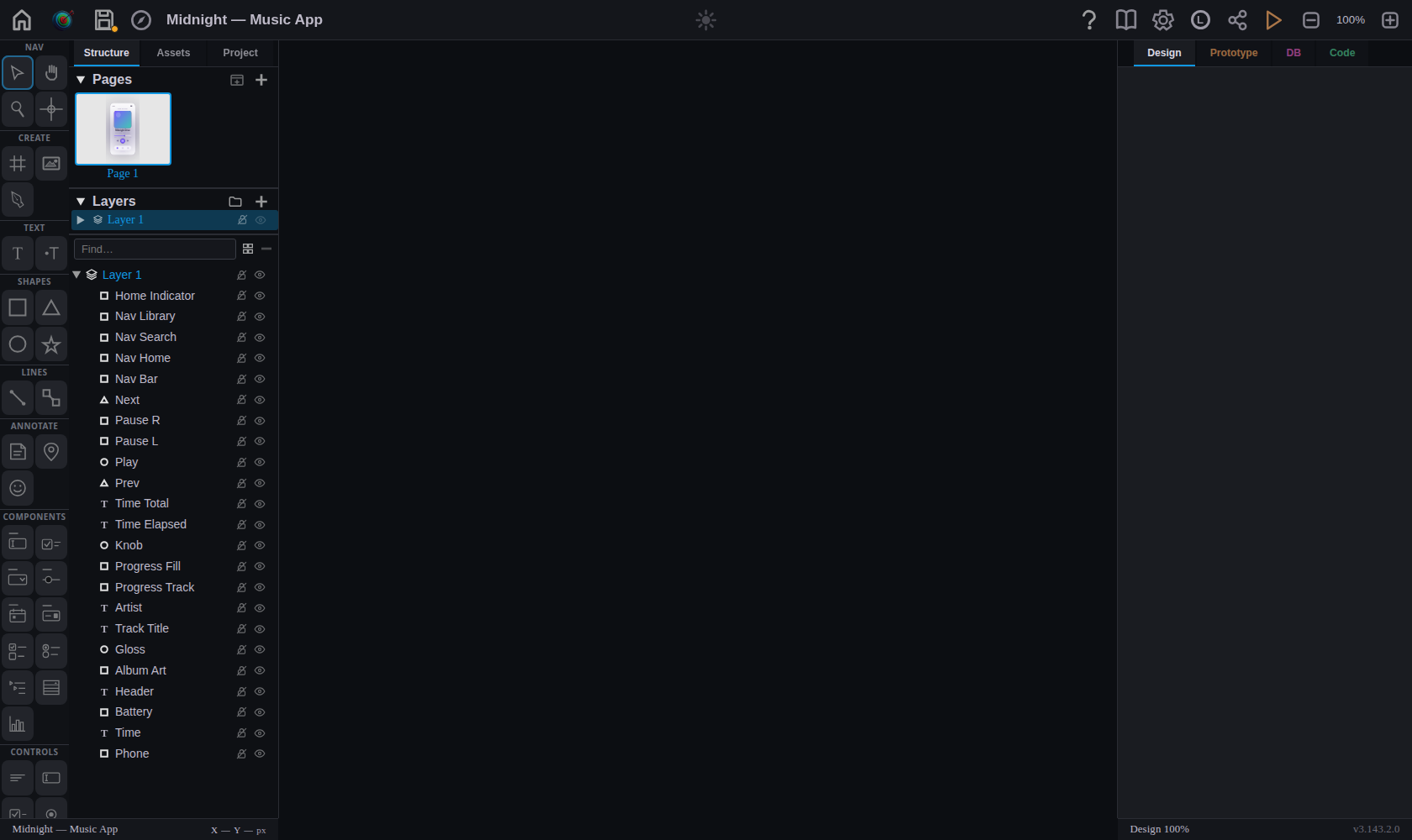
Built for real design work.
This half is finished and in daily use — the drawing, the type, the design system and the prototyping. More lands regularly between now and launch.
Shapes and text
Rectangles, ellipses, triangles, stars, regular polygons, and text — fixed text boxes or point text that grows as you type, with rich formatting and full font, weight, and alignment control.
Boolean operations
Union, intersection, difference, exclusion, and outline — backed by a Martinez-Rueda polygon clipping engine with 2,000 randomized fuzz cases behind it.
Bezier pen tool
Draw paths with full handle and node editing. Snap to grid, existing nodes, or segments while you work, and edit handles non-destructively.
Fill, stroke, shadow, masks
Solid colors, linear and radial gradients with draggable on-canvas handles, dashed strokes with configurable width and alignment, drop shadows, and vector clip masks.
A real design system
Color, text, and spacing tokens that propagate everywhere they're used, reusable templates, style classes you build visually, auto-layout stacks, and constraints that hold when a frame resizes.
Prototypes and animation
Click, drag, hover, and key-down triggers on any object — navigate frames, scroll, open links, set variables, branch with if/then logic — plus animation sequences on a storyboard timeline.
Images and effects
Drop a picture into any shape and crop it by dragging, adjust its brightness and contrast, and add inner shadows, layer blur and background blur — plus corner smoothing when a rounded corner should be a squircle.
Charts and spreadsheets
Ten kinds of chart, and a spreadsheet you edit on the canvas — the sheet holds the numbers, the chart draws them, and both are ordinary objects in the design.
Where it's going: from intent to a working app.
The part that makes it more than a drawing tool — and the part still being built. Each step feeds the next, and the Build Guide walks the whole path. It runs today, in the open; take it as a preview rather than a promise.
1 · Program Scope
Declare what the app is actually for — who uses it, what it has to do — before a single screen exists. Everything downstream is generated against that intent.
2 · Your data model
Model entities, fields, and relationships in the Code tab. The model is the source of truth for the screens, the back end, and the generated code.
3 · The screens follow
You don't draw the app's structure — the model implies it. Every entity gets its real record flow: browse a list, view a record, add or edit it, wired together, with a shared nav bar. The Screens page shows what was derived, and you adjust from there.
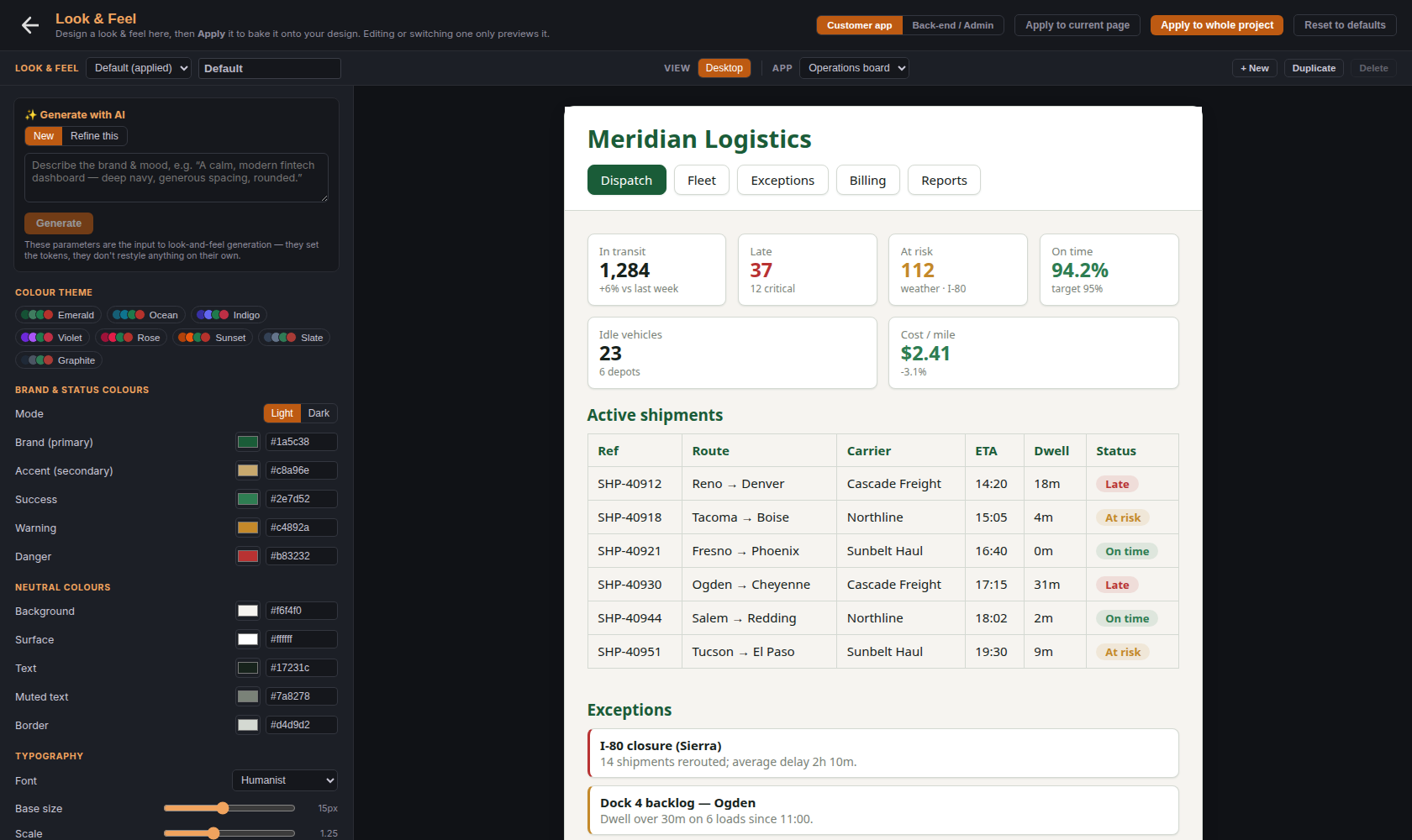
4 · Look & Feel
One set of design decisions — color, type, spacing, layout, nav placement, device targets — previewed live on three sample apps, including a deliberately busy one where the trade-offs actually show.
5 · Generate the design
Turn that structure and look & feel into a real, styled, editable design on a new canvas page — deterministically, or with AI from a prompt. It's your design afterward: every object is a normal, editable object.
6 · Front end and back end
Generate the app's code from the same model — plus a designed back end: endpoints, reports, business rules, scheduled jobs, file uploads and auth, with its own admin look & feel. Flows can call another service, send an email, or deliver a signed webhook.
7 · One design per device
Target more than one device and generating lays out a row of screens per device — Desktop, Tablet, Phone — as three real designs you can lay out separately, sharing the nav through one template. The built app shows the row that fits the window.
8 · Pick your stack
The same design compiles to seven back ends — TypeScript, Python, Go, Java, C#, Ruby, Rust — against seven databases: Postgres, SQLite, MySQL, MariaDB, MongoDB, SQL Server, Oracle. The client comes out as a web app, a phone app, a desktop app, a command line, or an API on its own.
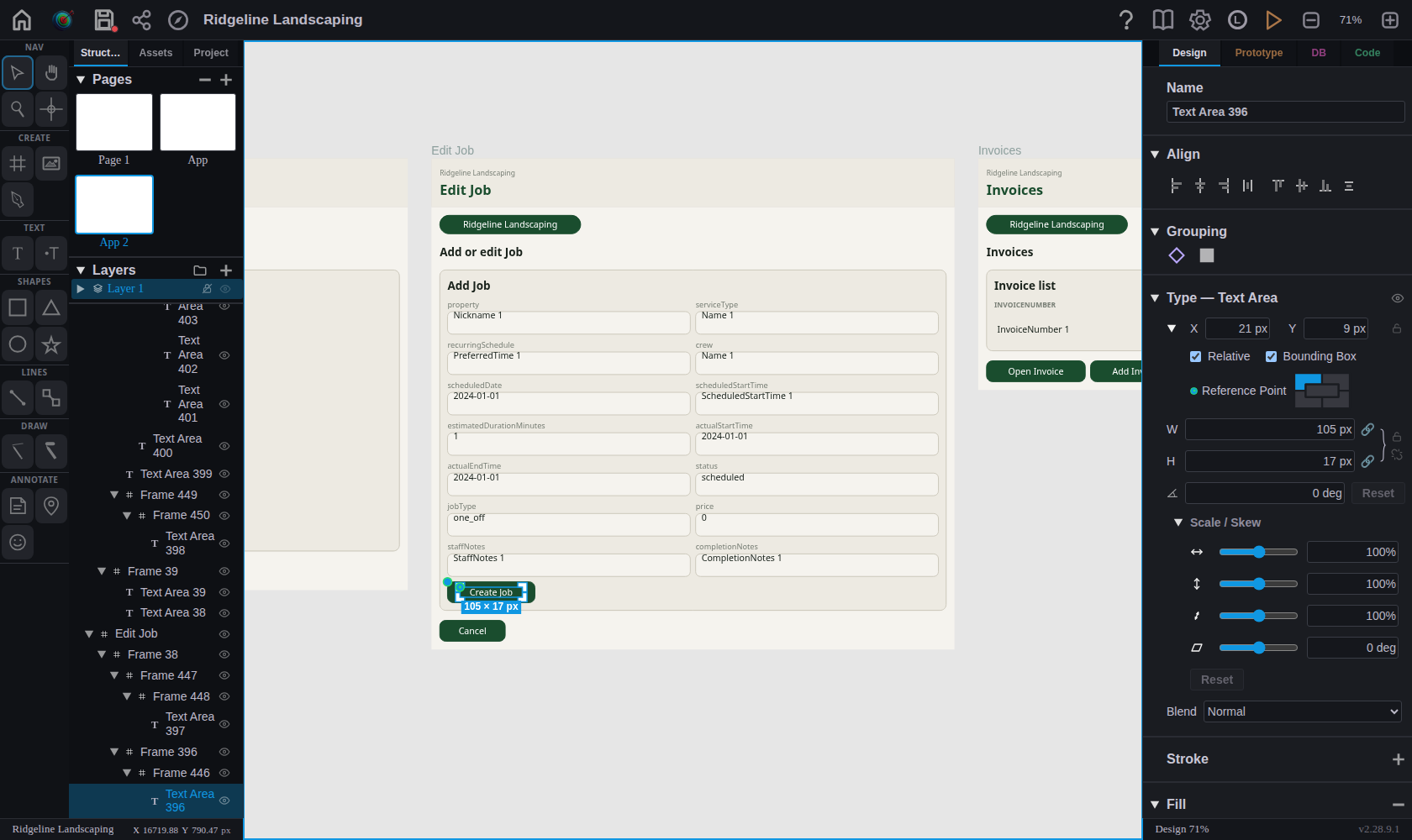
UML and flow diagrams
Sequence, use-case, and state-machine diagrams alongside the canvas — and a state machine's transitions can become real intents in the app you're building.
Live collaboration
Work on a project together and see your collaborators' cursors move as they work. Still experimental — it works, and it hasn't been through the hammering the rest of the app has.
Help on every control
A help mode that explains any individual control you point at, full in-app documentation, and a tour of the whole editor.
FS Tracker — the work you track becomes the invoice.
The project-and-time tracker I built to run Fletcher's Software: projects, phases, tasks, billable time, recurring work, expenses, invoicing, reports, and a calendar in one place — instead of a task tool, a time tracker, an invoicing app, and a spreadsheet that don't talk to each other. It runs my own studio every day.
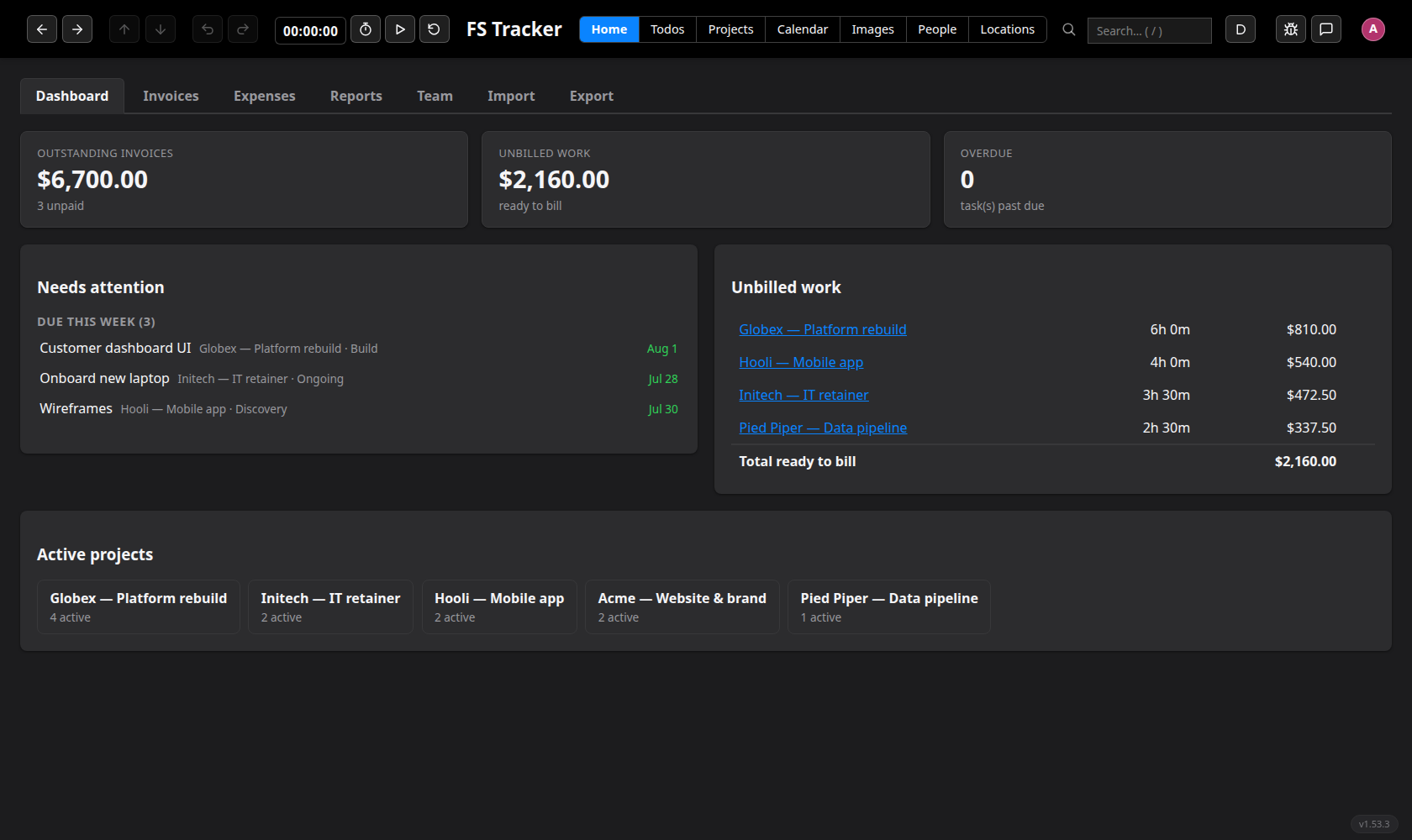
What a small studio runs on.
Track billable time
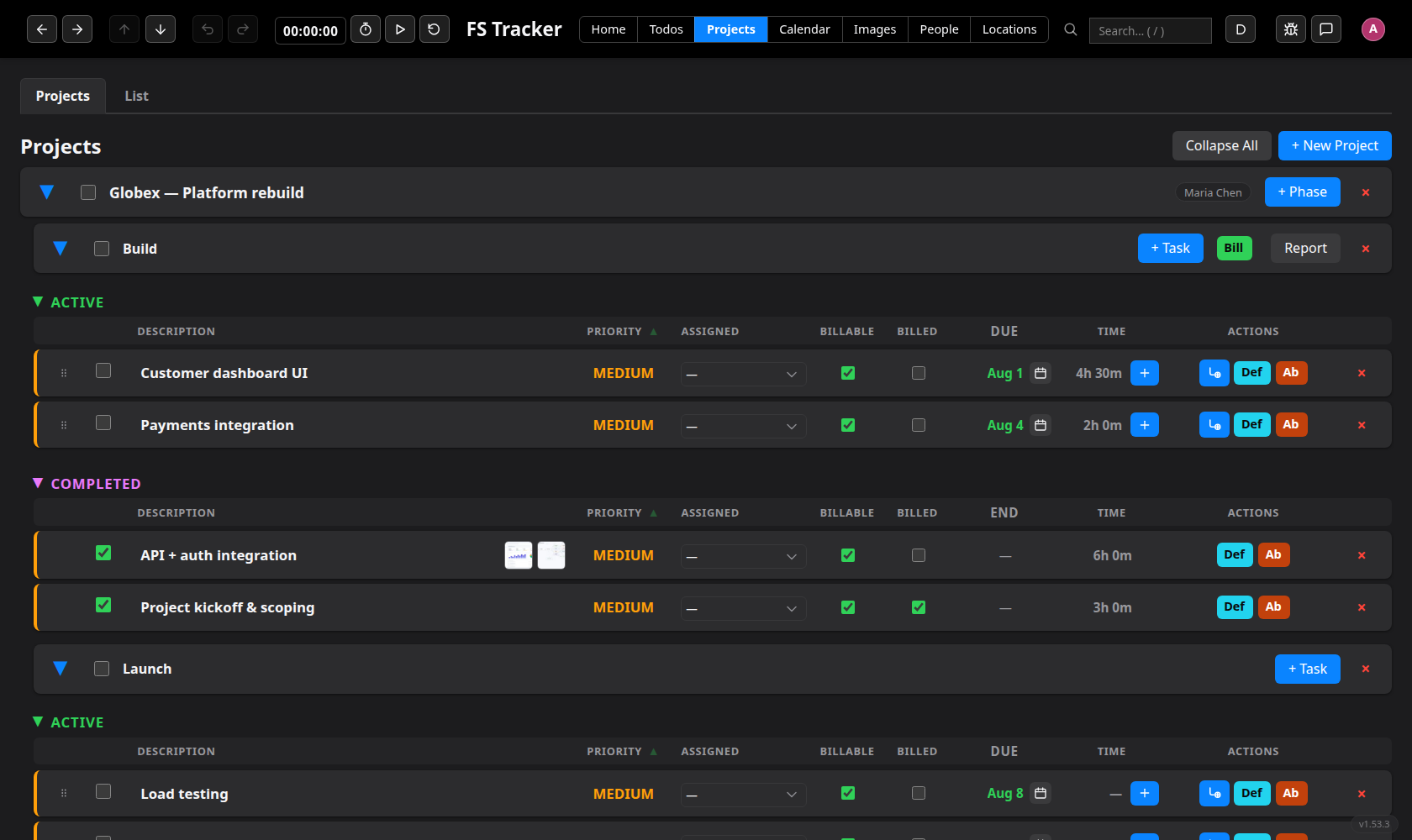
Projects break into phases and tasks, with a timer on any task — count up or count down, with your own alarm sound. Billable and non-billable time are tracked separately, so only billable hours reach the invoice.
Invoice and get paid
Turn unbilled time and expenses into an itemized invoice in a click, then send a private link clients pay online by card. Retainers go out on their own schedule as recurring invoices.
Recurring work that recurs
Retainers, monthly check-ins, and maintenance scheduled by real rules — nth weekday, day of month, week parity, holiday-aware — not just "every two weeks". Recurring expenses too.
See what's profitable
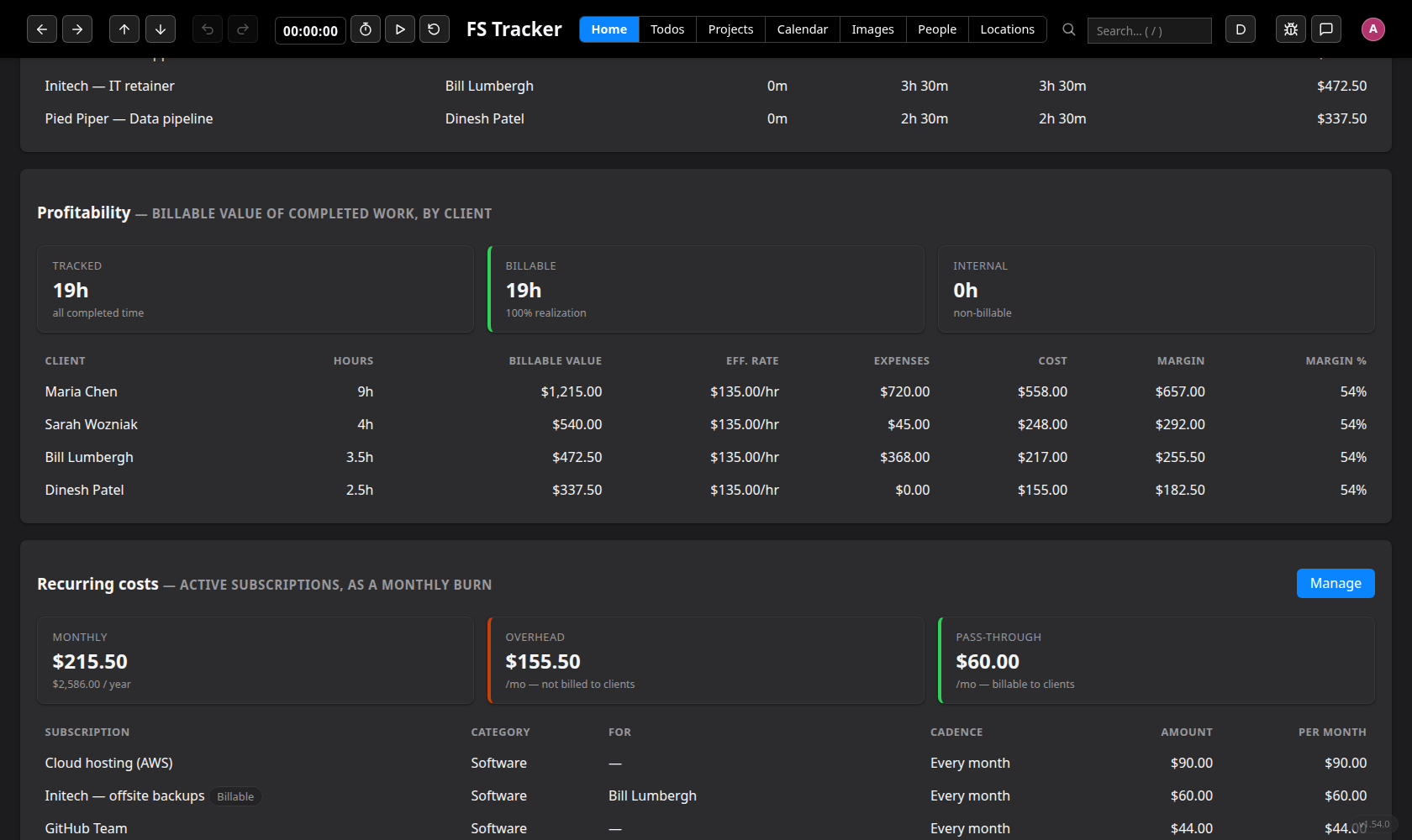
Give the studio a cost rate and every client gets a real margin — billable value, effective rate, expenses, cost, margin percent. Plus work by project, invoices by client, your monthly subscription burn, a To Be Billed view that catches uninvoiced time, and CSV out of any of it.
One calendar
Tasks, to-dos, invoices, and expenses on one calendar, with your Google and Microsoft calendars fed in beside them — and you can create a new calendar without leaving the tracker.
Your data, in and out
Import and export your own data as CSV or JSON, drive the whole tracker from its JSON API or its built-in MCP server, and link a project straight to its design in FS Designer.
Want a closer look?
Both are free during the alpha — take a look and start a project.
See FS Designer → See FS Tracker →or text (480) 276-5806